
Community-based multi-hop wireless networks is disruptive to the current broadband Internet access paradigm, which relies on cable and DSL being deployed in individual homes. It is important because it allows free flow of information without any moderation or selective rate control. Compared to the large DSL and cable modem systems that are centrally managed, mesh networking is organic — everyone in the neighborhood contributes network resources and cooperates.
Overview
Researchers in Microsoft Research Redmond, Cambridge, and Silicon Valley are working to create wireless technologies that allow neighbors to connect their home networks together. There are many advantages to enabling such connectivity and forming a community mesh network. For example, when enough neighbors cooperate and forward each others packets, they do not need to individually install an Internet “tap” (gateway) but instead can share faster, cost-effective Internet access via gateways that are distributed in their neighborhood. Packets dynamically find a route, hopping from one neighbor’s node to another to reach the Internet through one of these gateways. Another advantage is that neighbors can cooperatively deploy backup technology and never have to worry about losing information due to a catastrophic disk failure. A third advantage is that this technology allows bits created locally to be used locally without having to go through a service provider and the Internet. Neighborhood community networks allow faster and easier dissemination of cached information that is relevant to the local community.
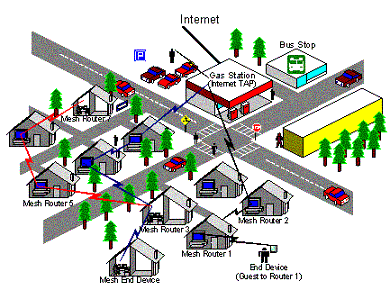
Community-based multi-hop wireless networks is disruptive to the current broadband Internet access paradigm, which relies on cable and DSL being deployed in individual homes. It is important because it allows free flow of information without any moderation or selective rate control. Compared to the large DSL and cable modem systems that are centrally managed, mesh networking is organic — everyone in the neighborhood contributes network resources and cooperates.
However, to realize the community-based goal, one has to solve many challenging problems including; capacity and range enhancement, privacy and security, self-stablizing and multi-path multi-hop routing, auto-configuration, bandwidth fairness, etc. In addition to solving the tough problems, success also depends on spectrum etiquette, business models, and economics. We are investigating some of the fundamental technical problems that continue to remain challenging despite several decades of research in packet radio networks. We have deployed testbed networks in our office buildings and in a local apartment complex.
-
Mesh Kit software download no longer available
We implement ad-hoc routing and link quality measurement in a module that we call the Mesh Connectivity Layer (MCL). Architecturally, MCL is a loadable Microsoft Windows driver. It implements a virtual network adapter, so that to the rest of the system the ad-hoc network appears as an additional (virtual) network link. MCL routes using a modified version of DSR (an IETF protocol) that we call Link Quality Source Routing (LQSR). We have modified DSR extensively to improve its behavior, most significantly to support link quality metrics.
The MCL driver implements an interposition layer between layer 2 (the link layer) and layer 3 (the network layer). To higher layer software, MCL appears to be just another Ethernet link, albeit a virtual link. To lower layer software, MCL appears to be just another protocol running over the physical link.
This design has several significant advantages. First, higher layer software runs unmodified over the ad-hoc network. In our testbeds, we run both IPv4 and IPv6 over the ad-hoc network. No modifications to either network stack were required. Network layer functionality (for example ARP, DHCP, and Neighbor Discovery) just works. Second, the ad-hoc routing runs over heterogeneous link layers. Our current implementation supports Ethernet-like physical link layers (e.g. 802.11 and 802.3) but the architecture accommodates link layers with arbitrary addressing and framing conventions. The virtual MCL network adapter can multiplex several physical network adapters, so the ad-hoc network can extend across heterogeneous physical links. Third, the design can support other ad-hoc routing protocols as well.
-
- Mesh Connectivity Layer Documentation (opens in new tab). Please read this documentation for information about how to install and use MCL.
-
-
We have a mailing list for discussing the Mesh Connectivity Layer. Please use this mailing list for questions about the release. To join the list (opens in new tab), send “subscribe” email to mcl-users-request@list.research.microsoft.com. Only subscribers can send email to the list (opens in new tab) at mcl-users@list.research.microsoft.com.
-
- Crash Course in Wireless Mesh Networks (opens in new tab), IEEE INFOCOM 2007, May 6, 2007, Anchorage, Alaska
- Wireless Mesh Networks: From Theory to Deployed Systems (opens in new tab), SIGCOMM 2006, September 11, 2006, Pisa, Italy
-
Publications
Algorithms & Software
- L. Qiu, Y. Zhang, F. Wang, M. K. Han, R. MahajanA General Model of Wireless Interference (opens in new tab)ACM MobiCom 2007, Montreal, Canada, September 2007
- B.-J. Ko, V. Misra, J. Padhye, D. RubensteinDistributed Channel Assignment in Multi-Radio 802.11 Mesh Networks (opens in new tab)IEEE WCNC 2007, Hong Kong, China, March 2007
- R. Mahajan, M. Rodrig, D. Wetherall, J. ZahorjanAnalyzing the MAC-level Behavior of Wireless Networks in the Wild (opens in new tab)ACM SIGCOMM 2006, Pisa, Italy, August 2006
- L. Qiu, P. Bahl, A. Rao, L. ZhouTroubleshooting Wireless Mesh Networks (opens in new tab)Computer Communications Review 2006
- J. Eriksson, S. Agarwal, P. Bahl, J. PadhyeFeasibility Study of Mesh Networks for All-Wireless Offices (opens in new tab)ACM/USENIX MobiSys, Upsalla, Sweden, June 2006.
- P. Kyasanur, J. Padhye, and P. BahlOn the Efficacy of Separating Control and Data into Different Frequency Bands (opens in new tab)IEEE BroadNets 2005 , Boston, Massachusetts, USA (October 2005)
- L. Qiu, R. Chandra, K. Jain, and M. MahdianOptimizing the Placement of Integration Points in Multi-hop Wireless Networks (opens in new tab)A revised version will appear in IEEE ICNP 2004.
- R. Draves, J. Padhye, and B. ZillRouting in Multi-radio, Multi-hop Wireless Mesh Networks (opens in new tab)ACM MobiCom, Philadelphia, PA, September 2004.
- P. Bahl, R. Chandra, and J. DunaganSSCH: Slotted Seeded Channel Hopping for Capacity Improvement in IEEE 802.11 Ad-Hoc Wireless Networks (opens in new tab)ACM MobiCom, Philadelphia, PA, September 2004.
- R. Draves, J. Padhye, and B. ZillComparison of Routing Metrics for Static Multi-Hop Wireless Networks (opens in new tab)ACM SIGCOMM, Portland, OR, August 2004.
- L. Qiu, P. Bahl, A. Rao, and L. ZhouFault Detection, Isolation, and Diagnosis in Multi-hop Wireless NetworksMicrosoft Technical Report, Microsoft Research-TR-2004-11, December 2003.
- K. Jain, J. Padhye, V. Padmanabhan, and L. QiuImpact of Interference on Multi-hop Wireless Network Performance (opens in new tab)ACM MobiCom, San Diego, CA, September 2003.
- A. Adya, P. Bahl, J. Padhye, A. Wolman, and L. ZhouA Multi-Radio Unification Protocol for IEEE 802.11 Wireless NetworksIEEE BroadNets 2004.
- L. Li, J. Y. Halpern, P. Bahl, Y-M. Wang, and R. WattenhoferA Cone-Based Distributed Topology-Control Algorithm for Wireless Multi-Hop Networks (opens in new tab)Accepted for publication in the IEEE/ACM Transactions on Networking.– download our IEEE INFOCOM 2001 paper on the same topic by clicking here (opens in new tab)– download our ACM PODC 2001 paper on the same topic by clicking here (opens in new tab)
- G. Holland, N. Vaidya, and P. BahlA Rate-Adaptive MAC Protocol for Multi-Hop Wireless Networks (opens in new tab)ACM MobiCom 2001, Rome, Italy, July 2001.
Antennas & Hardware
- Y Kuga, J. Cha, J. A. Ritcey, and J. KajiyaMechanically Steerable Antennas Using Dielectric Phase Shifters (opens in new tab)IEEE AP-S International Symposium and USNC/URSI National Radio Science Meeting, June 2004.
Spectrum Policy & Etiquette
- V. Brik, E. Rozner, S. Banerjee (University of Wisconsin), and P. BahlDSAP: A Protocol for Coordinated Spectrum AccessIEEE DySPAN 2005, Baltimore, MD. November 2005
- P Bahl, P. DeVries, A. Hassan, J. Kruys (Cisco), and S. Mangold (Philips)Wi-Fi Alliance White Paper On Spectrum Sharing and Co-existence – First Phase, Internal Wi-FI Alliance Paper (will be available shortly).
- P. DeVries and P. BahlMicrosoft’s Proposal for Initiating Discussions on Spectrum Etiquette in the 5 Ghz Band (opens in new tab) (Real Time Video from Stanford Law School, 3/2/03, 42 mins. 58 secs)
- P. Bahl, A. Hassan, and P. DeVriesDraft Proposal for Comment: Etiquette Rules and Procedures for Unlicensed Bands (opens in new tab)Proposal to the Industry and the FCC to generate discussions and interest, Version 1.1, January 27, 2003.
Presentations (Keynotes & Plenary talks)
- P. Bahl, Plenary Talk @ the Texas Wireless Symposium (opens in new tab), October 26, 2005, Austin, Texas
- P. Bahl, Conference Keynote @ the International Symposium on Wireless Communication Systems (ISWCS) (opens in new tab), September 6, 2005, Siena, Italy
- P. Bahl, Conference Keynote @ the International Conference on Mobile Business (ICMB) (opens in new tab), July 11, 2005, Sidney, Australia
- R. Rashid, Conference Keynote @ the Mobile Systems Conference (MobiSys) (opens in new tab), June 6, 2005, Seattle, Washington
- P. Bahl, Workshop Keynote, Opportunities and Challenges of Community Mesh Networking (opens in new tab), MICS Workshop ETH Zurich, June 2004 (this talk was also presented at the Annual MSR Faculty Summit in Redmond, Washington on August 3, 2004)
- P. Bahl, Spectrum Policy: Property or Commons? (opens in new tab), Stanford Law School, March 2, 2003,Spectrum Etiquettes for Short Range Wireless Devices Operating in the Unlicensed Band – A Proposal (opens in new tab)
Vision Video
- Mesh networking (opens in new tab) (4 min. 6 sec.)
-
- Wireless Community Mesh Networks – Hype or next big Frontier? (opens in new tab) ACM MobiCom 2004 Panel, Philadelphia, PA, September 29, 2004
- Mesh Networking Summit 2004. A 2-day mindswap event between reseachers from industry, academia, and government to discuss Mesh Networking. Organized by Microsoft Research, June 23-24, 2004 (Check out all the talks, videos and presentation decks avaialble on web site)Press Report, Snoqualmie Falls, Washington, June 24, 2004
-
- Information Week, Wireless Meshing: Microsoft is working on software to make Internet access cheaper for remote locations (opens in new tab) by Martin J. Garvey, June 13, 2005
- EE Times, Mesh Casts Wider Networks (opens in new tab) by Rick Merritt, March 28, 2005
- DataQuest, Microsoft Displays next-gen computing (opens in new tab), MSR TechFest coverage on Mesh by Kapil Dev Singh, March 4, 2005
- MSR Web News, Your Neighborhood Network Article by Suzanne Ross, June 2004
-
- Researchers from Microsoft Research Redmond, Microsoft Research Cambridge, and Microsoft Research Silicon Valley.
- As an intern, Yih-Chun Hu implemented DSR within the MCL framework; this was our starting point for developing LQSR.
Mesh Networking Academic Resource Toolkit 2005, 2007 (Retired)
If you are a faculty member or researcher at an accredited academic institution such as a university or college, you are invited to apply for our Mesh Networking Academic Resource Toolkit (Mesh Kit software download no longer available)– a research and teaching resource for exploring core technologies in wireless networks. This contains all the software and documentation you will need to get started.
People

Victor Bahl
Technical Fellow & Chief Technology Officer, Azure for Operators

Jitu Padhye
Partner Development Lead